
Shiksha Study Abroad Launches Shiksha Popularity Rank
 Talk to Expert
Do you come across Shiksha Popularity Ranking often and do not know what is the significance? We will help you understand what is Shiksha Popularity ranking and how it can help you shortlist universities for admissions abroad. Chec out the article for more details.
University ranking is very important in decision making for someone who is planning to study abroad. But you check out there on the web - you find many ranking bodies like Bloomberg, Financial Times, Guardian University Rankings, QS Universities Rankings, Times Higher Education (THE), US News. Different sources have different ranking methodology thus college A ranking 4 on Bloomberg might rank 2nd on QS. Well this is where Shiksha Study Abroad steps in with the Shiksha Popularity Rank. We are sorting ranks from all these sources to give you a clear, consolidated view that helps you confidently choose the university that aligns best with your academic and career aspirations.
- What is Shiksha Popularity Rank?
- How is Shiksha's Popularity Rank Calculated?
- Benefits of choosing Shiksha Popularity Rank
What is Shiksha Popularity Rank?
Shiksha Popularity Rank is a simple ranking system that helps you choose the best university for studying abroad. It collects ratings from trusted sources and turns them into an aggregated rank with clear letter grade, so you can see how well an institute performs overall and for specific courses. It even breaks down the rankings into different levels:
- Global Level: How the university ranks in the world (like Harvard's global rank).
- Country Level: How the university ranks in its own country (like Harvard's rank in the USA).
- Base Course Level: How the university ranks for a particular type of course (for example, Harvard's rank for an MS program).
- Stream Level: How the university ranks in a broader subject area (such as Engineering).
- Specialization Level: How the university ranks for a specific subject (like Computer Science). This makes it easy to compare institutions, saves you time, and helps you pick the right university for your studies and future career.
Also Read:
| QS World University Rankings - Global MBA Rankings Methodology |
|
How is Shiksha's Popularity Rank Calculated?
Let's use this Harvard Ranking as an example to understand how Shiksha calculates the rank:

-
Gather All Available Ranks
Shiksha collects Harvard’s position from each publisher. For example, ARWU might show Harvard at #1, THE at #3, and so on. -
Consolidate and Compare
These different rankings are then combined and balanced against one another, making sure no single source dominates the final outcome. -
Adjust for Variations
Because each ranking body has its own method (e.g., some might report exact ranks, others give rank ranges), Shiksha applies a consistent approach to standardize this data and displays the calculated single Shiksha rank which in this case #4. This gives students an at-a-glance view of how Harvard stands when multiple ranking sources are considered together.
While the precise calculations stay under the hood, the overall idea is that Shiksha merges several reputable rankings into one easy-to-understand position.
Related Reads:
| US News' Best Colleges Rankings (National Universities) Methodology |
|
Benefits of choosing Shiksha Popularity Rank
Here is some of the reasons why you should rely on Shiksha Popularity Rank:
| Benefit | How It Helps You |
|---|---|
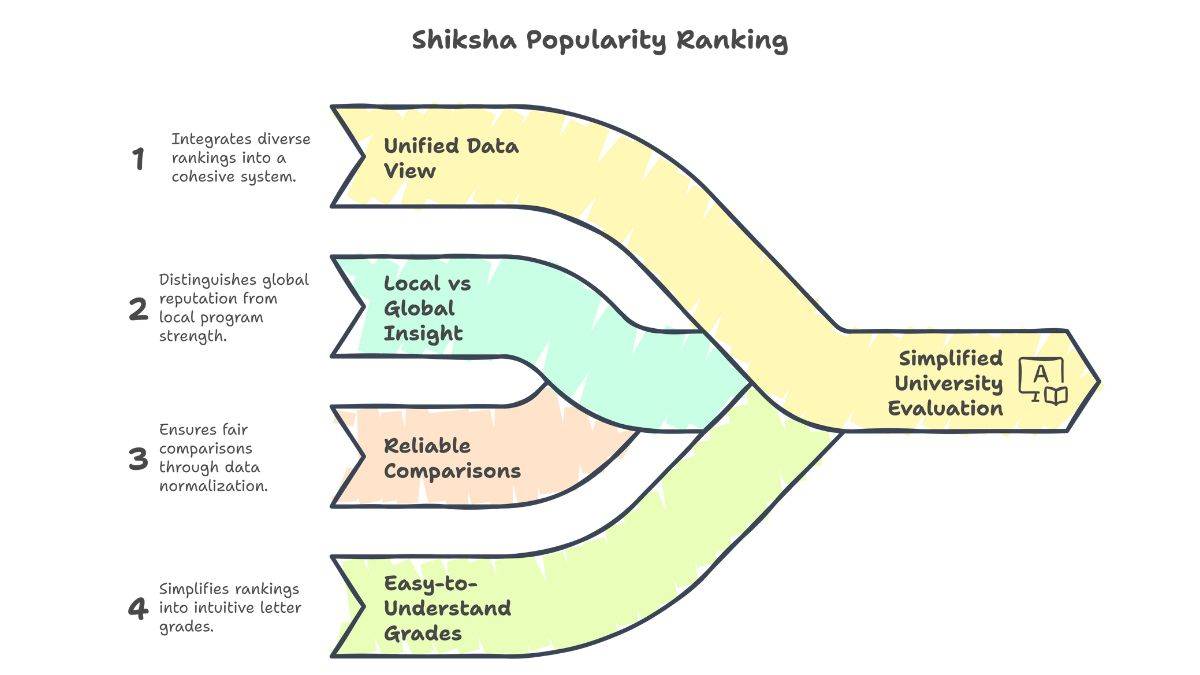
| Unified Data View | Consolidates rankings from multiple sources into a single, standardized system—no more juggling conflicting numbers from different publishers. |
| Local vs Global Insight | It separates overall university performance from course-specific data so you can evaluate both the institution’s global reputation and its strength in particular programs locally. |
| Reliable Comparisons | Uses normalisation to adjust for differences in data sources - ensuring fair and statistically sound comparison between institutions and courses |
| Simpler Grades | Translates complex ranking data into simple ranks and letter grades (A+, A, A–, etc.) giving you a quick at a glance understanding of university’s or program’s standing |

Commonly asked questions
Yes, it is possible for Indian students to study in the UK for FREE, generally via fully-funded scholarships like the ones listed below:
- Chevening Scholarships
- Commonwealth Scholarships
- GREAT Scholarships
- Gates Cambridge Scholarships
While these scholarships cover both tuition + living costs, expenses like visa fees, health surcharges, and initial travel costs will still need to be budgeted for by students.
The application fees for universities abroad are not the same and may vary significantly. The average application fees to abroad universities generally range from $50 to $150. The fees for programs like the MBA reaches up to $150, for rest other courses, this fees may be less.
Among top ranked Universities offering Global MBA as ranked by QS ranking, few have acceptance rate above 10%, which means it is highly difficult to get acceptance in these Universities for studying MBA in International Business. The table below mentions those top ranked universities which have acceptance rate above 10%:
Business Schools | QS ranking | Acceptance rate |
|---|---|---|
The Wharton School (UPenn) | #1 | 20.5% |
Harvard Business School | #2 | 11.2% |
MIT (Sloan) | #3 | 14.1% |
London Business School | #6 | 25% |
HEC Paris | #5 | 11% |
Cambridge Judge Business School | #7 | 21% |
IE Business School | #11 | 32% |
IESE Business School | #15 | 26% |
Availing scholarships for handling expenses becomes important for international students to manage all university expenditures and cost of living, while studying in their dream university. Scholarships pay a great role in deciding a student's career prospect by decreasing the burden of expenses from their shoulders. There are various attractive Scholarships that can be availed by Indian Students for studying abroad. Some of them are:

 Statement of Purpose
 Letter of Recommendation
 Student Visa Application
 Admission Essay Writing
 Student Curriculum Vitae
Aishwarya Bhatnagar is a specialised content curator with 8+ years of experience in EdTech content, particularly in studying abroad. She is a Study Abroad Expert at Shiksha.com (InfoEdge India Ltd) si
Read Full Bio