
Computer Science Courses & Certifications Online
Computer Science is a rapidly evolving field that encompasses the study of computers and computational systems. Enrolling in online Computer Science courses can be a great option to learn more about this field and its various aspects.

Online Computer Science courses offer students the flexibility to learn at their own pace, providing an in-depth understanding of various computational theories and applications. These programs cover various subjects, such as algorithms, data structures, programming languages, software development, networking, and database management.
Explore Computer Science Online Courses & Certification
Why Learn Computer Science Online
- Access to Specialized Courses
Online programs offer a variety of courses for Computer Science, covering topics such as artificial intelligence, machine learning, cybersecurity, and big data. These specialized courses will help y
Computer Science is a rapidly evolving field that encompasses the study of computers and computational systems. Enrolling in online Computer Science courses can be a great option to learn more about this field and its various aspects.
Online Computer Science courses offer students the flexibility to learn at their own pace, providing an in-depth understanding of various computational theories and applications. These programs cover various subjects, such as algorithms, data structures, programming languages, software development, networking, and database management.
Explore Computer Science Online Courses & Certification
Why Learn Computer Science Online
- Access to Specialized Courses
Online programs offer a variety of courses for Computer Science, covering topics such as artificial intelligence, machine learning, cybersecurity, and big data. These specialized courses will help you learn tools and methodologies often unavailable in traditional settings.
- Flexibility for Students
Online learning allows current students and aspiring professionals to continue their education and enhance their skills without interrupting their careers. It enables them to balance work, studies, and personal life effectively.
- Exposure to Different Perspectives
Online Computer Science programs attract students from different regions and backgrounds. They provide exposure to various computational philosophies, cultural perspectives, and real-world projects on software development, networking, and data management.
- Networking with Industry Peers
Many online programs include virtual networking events, discussion forums, and collaborative projects. These allow students to connect with other developers and industry professionals globally, which can help expand their professional network significantly.
- Hands-on Experience with Development Tools
Online Computer Science courses typically include practical training with essential tools and platforms like GitHub, Visual Studio Code, and various programming languages. This prepares students for the practical aspects of developing and deploying software applications.
- Staying Updated with Technological Advances
Online Computer Science programs quickly update their curriculum to reflect the latest technologies, best practices, and industry standards in the field. This ensures that students learn the most current skills relevant to the job market.
- Specialised Development Tracks
Online Computer Science courses often offer specialized tracks like cybersecurity, data science, or software engineering. This allows students to customize their learning to specific interests and career goals within the broad field of Computer Science.
Career in Computer Science
| Position |
Job Role |
Average Salary (Per Annum) |
| Software Developer |
Builds and maintains software applications, ensuring efficient performance and usability. |
₹7.0 Lakhs |
| Data Scientist |
Analyzes and interprets complex data to help organizations make informed decisions. |
₹10.0 Lakhs |
| Network Engineer |
Designs and manages computer networks, ensuring secure and efficient communication. |
₹6.5 Lakhs |
| AI/ML Engineer |
Develops artificial intelligence and machine learning models for various applications. |
₹12.0 Lakhs |
| Web Developer |
Designs and develops websites, ensuring a seamless user experience. |
₹5.5 Lakhs |
| Database Administrator |
Manages and maintains databases to ensure data integrity and security. |
₹8.0 Lakhs |
| Cybersecurity Specialist |
Protects systems and networks from cyber threats and vulnerabilities. |
₹9.0 Lakhs |
| IT Consultant |
Provides expert advice on IT strategies and solutions to enhance business performance. |
₹11.0 Lakhs |
| Systems Analyst |
Analyzes and improves existing IT systems and processes to meet business needs. |
₹7.5 Lakhs |
| DevOps Engineer |
Combines software development and IT operations to improve the software delivery process. |
₹8.5 Lakhs |
Source: AmbitionBox
How to Learn Computer Science Online?
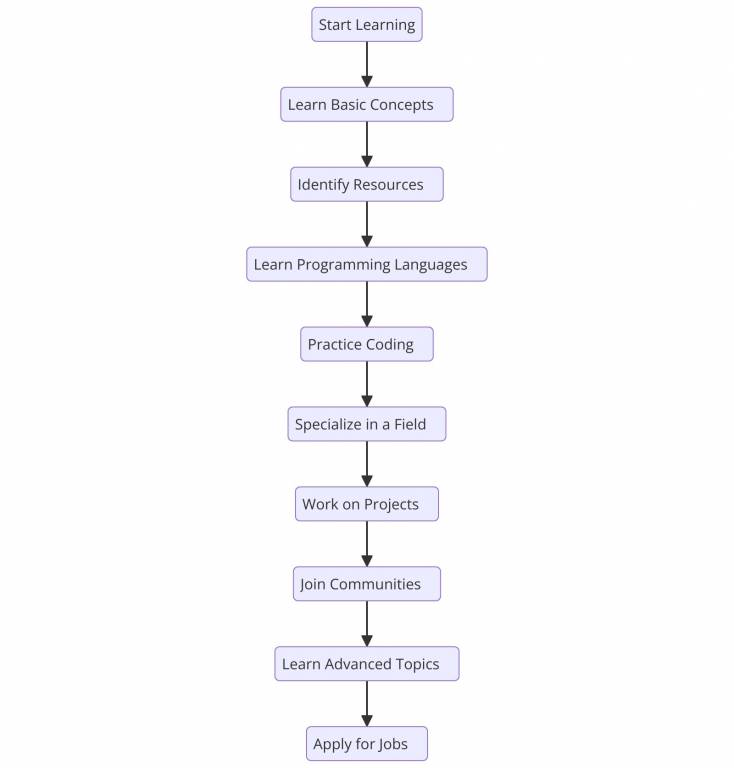
Below is a flowchart showing how to learn Computer Science online:
Eligibility Criteria For Admission in Computer Science Courses
The eligibility criteria for admission into Computer Science courses can vary depending on the course level (certificate, diploma, undergraduate, or postgraduate) and the institution offering the course. Here’s a general overview of the typical eligibility requirements:
| Criteria |
Details |
| Educational Qualification |
|
| Entrance Exams |
|
| Work Experience |
|
| Age Limit |
|
| Reservation Policy |
|
| Language Proficiency |
|
| Additional Requirements |
|
Syllabus of Computer Science Courses
| Module Topic | Subtopic | Learning Objectives |
|---|---|---|
| Module 1: Introduction | - What is Computer Science? | - Define computer science and its relevance. |
| - History of Computing | - Explore the evolution of computers and key milestones. | |
| - Career Opportunities | - Discuss potential career paths in computer science. | |
| Module 2: Programming | - Basics of Programming | - Understand fundamental concepts like variables, data types, and operators. |
| - Control Structures | - Learn about loops, conditionals, and decision-making in code. | |
| - Functions and Modularization | - Break down code into functions for better organization. | |
| Module 3: Data Structures | - Arrays and Lists | - Explore the concept of arrays and linked lists. |
| - Stacks and Queues | - Understand stack and queue data structures. | |
| - Trees and Graphs | - Learn about tree and graph data structures. | |
| Module 4: Algorithms | - Searching and Sorting | - Study common searching and sorting algorithms. |
| - Recursion | - Understand recursive algorithms and their applications. | |
| - Dynamic Programming | - Learn about dynamic programming techniques. | |
| Module 5: Databases | - Relational Databases | - Explore concepts of SQL and relational database design. |
| - NoSQL Databases | - Introduce NoSQL databases and their use cases. | |
| - Database Management Systems | - Understand DBMS and data security. | |
| Module 6: Web Development | - HTML and CSS | - Create web pages using HTML and style them with CSS. |
| - JavaScript | - Implement interactive web elements with JavaScript. | |
| - Backend Development | - Introduction to server-side scripting and databases. | |
| Module 7: Software Engineering | - Software Development Lifecycle | - Learn phases of software development from planning to maintenance. |
| - Version Control | - Use version control systems like Git for collaborative coding. | |
| - Testing and Quality Assurance | - Implement testing strategies to ensure software quality. | |
| Module 8: Cybersecurity | - Threats and Vulnerabilities | - Identify common cyber threats and vulnerabilities. |
| - Security Measures | - Implement security measures and best practices. | |
| - Ethical Hacking | - Introduction to ethical hacking and penetration testing. | |
| Module 9: Artificial Intelligence | - Machine Learning | - Understand machine learning algorithms and applications. |
| - Neural Networks | - Explore artificial neural networks and deep learning. | |
| - Natural Language Processing | - Learn about NLP and its use in AI applications. | |
| Module 10: Capstone Project | - Project Proposal | - Propose a computer science project idea. |
| - Project Development | - Develop and implement the project. | |
| - Presentation and Report | - Present the project and submit a comprehensive report |
So, what are you waiting for? Master Computer Science now and live the life of your dreams!
 All FiltersClear All


- (4)
- (2)
- (2)
- (2)
- (2)
- (2)
- (1)
- (1)
- (1)
- (1)
- (1)
- (1)
- (1)
- (41)
- (32)
- (11)
- (10)
- (7)
- (4)
- (4)
- (3)
- (3)
- (2)
- (2)
- (1)
- (1)
- (1)
- (1)
- (1)
- (1)
- (1)
- (1)
- (3)
- (10)
- (5)
- (13)
- (30)
- (34)
- (1)
- (7)
- (16)
- (116)
Computer Science Courses & Certifications Online


Commonly asked questions On Computer Science Online Courses & Certifications
Both are closely related fields. Simply put - Computer Science is the creation of software & hardware by using programming. IT is just the selection of the proper software or hardware for the task. CS is basically working with the physical component of computers like processors, supercomputer and dealing with the software which runs them basically making hardware and software and IT deals with selecting proper software to run the machines.
The decision can be quite overwhelming for students straight out of class 12.
To know for sure, ask yourself if the subjects are resonating with you. If you have a genuine interest or not. One can pursue a course in CS if he/ she has keen interest in -
Computer Science, Computer Applications, basics of top Programming Languages, Data Analysis, Problem-solving ability, Logical Reasoning, Numerical Ability, etc.
Read more on -
With good skills, experience/ projects in resume you can apply for roles like - Software engineer, Web developer, Data scientist, Database, Cybersecurity analyst, Data analyst etc. There is good scope in research & academia as well. Though a few places might prefer a pure tech degree.
You can aspire to work in areas like - IT firms, startups or academia abroad. Make sure you meet language proficiency test, additional qualifications, work visa, etc. If you are planning to pursue MS abroad, note that some universities may prefer BTech for that.
You can consider Computer Science courses to be ideal if you want to get into tech, academia, research, plan for a master's too. The core focus could vary across course types but some general topics are - Software and Algorithms, Application, Engineering and Hardware. CS specializations include AI, ML, Cloud Computing, Cyber Security etc.
Read more:


 Collections often explored by students
Commonly asked questions On Computer Science Online Courses & Certifications
Relevant skills, experience and projects can lead you to job roles like - Software engineer, Web developer, Data scientist, Database, Cybersecurity analyst, Data analyst etc. Or you can go into research & academia as well. You can either go for a tech degree like BTech CS, M.Tech CS or academic degrees like BSc, MSc.
Read more on -
The 'better' course depends on various factors. Some of the core differences between the two are covered below:
BSc Computer Science: A 3-year UG academic degree in Computer Science. Usually preferred to get into research & academia. Though one can also work in roles like developer, analyst, or engineer after this course if they have a relevant skillset. Though the curriculum has both theory & lab work included, it is still more of a theory-driven course focused on CS fundamentals. BSc CS has a shorter duration, an easier entry, and an affordable cost.
BTech CSE: By the name, a 4-year tech degree. Comparatively more advanced & application-based approach. Probably the most preferred for tech roles (ofcourse if you have the skills). Extensive labs works in the curriculum. The fee structures are usually high with highly competitive entry in top colleges. A bit more acceptable by foreign companies & universities for pursuing a Master's.

 ScienceComputer Science