📄
Class 12 CBSE Notes
Worried about the pending board syllabus?
Revise 12th Class Notes. / Preparation Physics Ray Optics and Optical Instruments
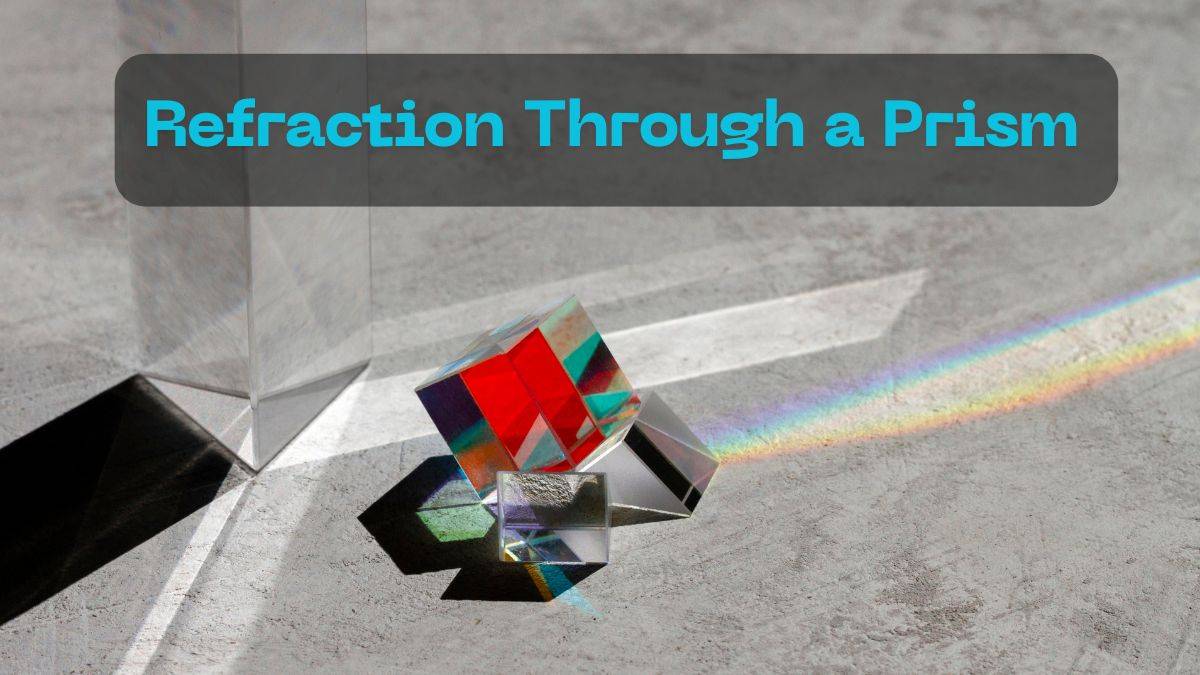
Refraction of light through a prism happens when a light ray enters a triangular-shaped object called a prism. Light ray in a prism bends twice, which results in the light deviating from its original path. As a result, the emergent ray does not remain parallel to the incident ray. Since different wavelengths of light refract at slightly different angles, the white light gets dispersed into constituent colours.
In this article, we will explain refraction through a prism in detail along with the derivation of refractive index of prism. Once you have understood the topic, start practising the NCERT excercise on Ray Optics and Optical Instruments.


Let us explain refraction of light through a glass prism in a step-by-step manner:

We have also attached a simulation that you can look at to understand how refraction through a prism takes place.
Class 12 CBSE Notes
Worried about the pending board syllabus?
Revise 12th Class Notes.11th CBSE Notes
Class 11th topics left before exams?
Revise 11th CBSE notes.Let us understand the step-by-step derivation of the refractive index of a prism:
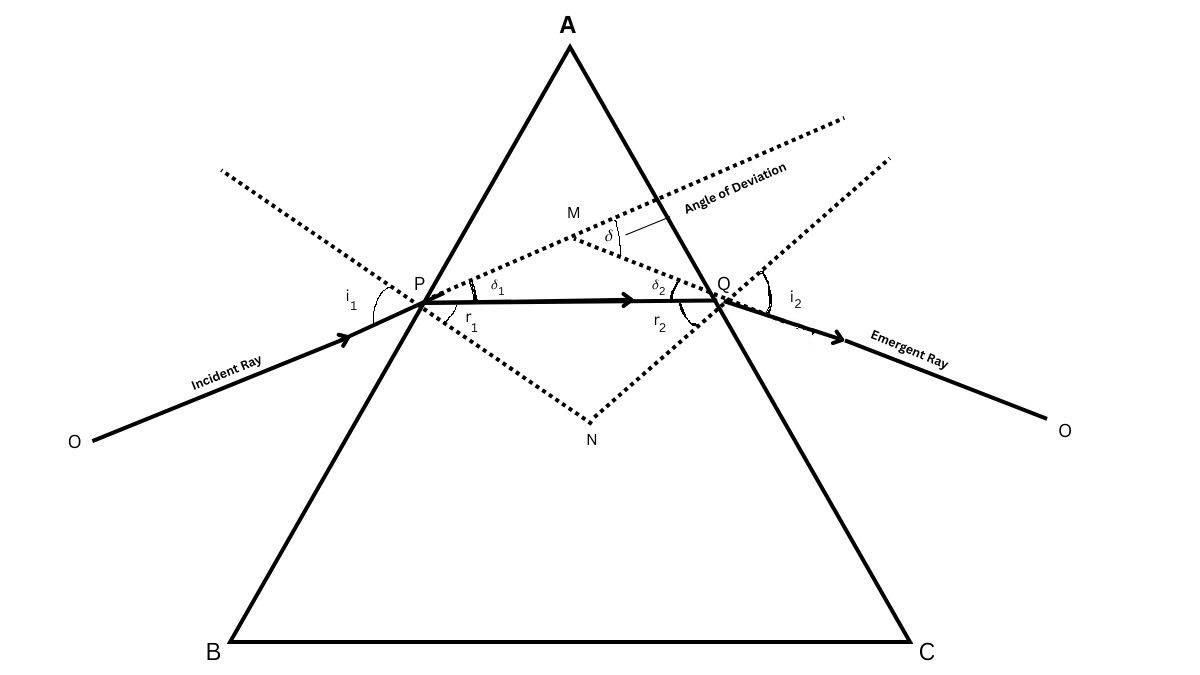
From the above figure, we can tell that
𝛿 = 𝛿₁ + 𝛿₂
= ( i₁ - r₁) + ( i₂+ r₂)
= ( i₁ +i₂ ) - ( r₁+ r₂) - (1)
As we know by basic geometry rules, the sum of angles in a triangle is 180° which means that
∠APR + ∠A + ∠AQR = 180°
(90° - r₁) + ∠A + (90° - r₂) = 180°
( r₁+ r₂) = ∠A - (2)
Let us substitute the values of equation 2 in equation 1:
𝛿 = ( i₁ +i₂ ) - ∠A - (3)
For the case of minimum deviation
i₁ =i₂ =i
We will now use this equivalence relation in equation 3.
𝛿 = ( i +i ) - ∠A
𝛿 = ( 2i ) - ∠A
i = (𝛿 + ∠A)/2
Since r₁= r₂ =r, we will modify equation 2 as mentioned below:
(r₁ +r₂) = ∠A
(r + r) = ∠A
2r = ∠A
r = ∠A/2
Therefore, refractive index for a medium of prism for the minimum deviation angle (𝛿𝑚) will be:
Knowing this is important for JEE Main exam and NEET exam. As we have seen in the above section, a white light will disperse into a colourful spectrum of light when it passes through a prism. Let us understand why this happens:
Those students who are going to take class 12th CBSE board exams must remember that they need to have the knowledge of each topic of the subject. This is why we have created a note bank for students to revise all the chapters quickly:
| Name of Chapter |
Name of Chapter |
|---|---|
| Chapter 14 Semiconductor Electronics: Materials, Devices and Simple Circuits |
Here, we have shared the NCERT Exercise of Class 12th Physics chapters for students who are planning to take their board exams next year.
| Name of Chapter |
Name of Chapter |
|---|---|
| Chapter 14 Semiconductor Electronics: Materials, Devices and Simple Circuits |
This lesson has been reviewed by subject matter expert Raghvendra Kumar, who has years of experience in teaching. He has qualified for the AIEEE and GATE exams. He specialises in preparing students for JEE Main and NEET as well as for Class 11 and 12 subjects. As a reviewer at Shiksha, he ensures that content has clarity, correctness and exam readiness of concepts and explanation sets. To further maintain the quality of the content being shared on our website, we have referred to the study material provided by NIOS, NCERT and standard Physics books.
Let us take a look at the frequently asked questions related to refraction through a prism which may even be important for competitive exams like IIT JAM exam and CUET exam:

Physics Ray Optics and Optical Instruments Exam
 Anything you would want to ask experts?
Exams accepted
CA Foundation
Exams accepted
ICSI Exam
Exams accepted
BHU UET | GLAET | GD Goenka Test
Bachelor of Business Administration & Bachelor of Law
Exams accepted
CLAT | LSAT India | AIBE
Exams accepted
IPMAT | NMIMS - NPAT | SET
Exams accepted
BHU UET | KUK Entrance Exam | JMI Entrance Exam
Bachelor of Design in Animation (BDes)
Exams accepted
UCEED | NIFT Entrance Exam | NID Entrance Exam
BA LLB (Bachelor of Arts + Bachelor of Laws)
Exams accepted
CLAT | AILET | LSAT India
Bachelor of Journalism & Mass Communication (BJMC)
Exams accepted
LUACMAT | SRMHCAT | GD Goenka Test
