
KIITEE Dual Degree/ Integrated programmes Mock Test 2026: Get Free Online Practice Papers
Kalinga Institute of Industrial Technology Entrance Exam 2026 ( KIITEE )

 Registration - 10 Nov '25 - 8 Apr '26


KIITEE Mock Test 2026: Kalinga Institute of Industrial Technology (KIIT) will release the KIITEE 2026 mock test just a few days before the exam. Candidates will be able to practice the KIITEE BTech mock test online at kiitee.kiit.ac.in. By practising the mock test, aspirants will be able to understand the exam pattern, format and difficulty of the KIITEE exam.
Only registered candidates can access the mock test using their application number and password. Students must attempt the KIITEE 2026 mock test only after completing the syllabus for KIITEE 2026. The mock test is based on the KIITEE exam pattern and the syllabus. The authority has announced the KIITEE 2026 exam date for phase 1 as April 16 to 20. The KIITEE mock test will help students know their preparation level, identify strong areas, and work on topics where improvement is needed. For more details on KIITEE 2026 mock test, check the article below.
- How to Access KIITEE Mock Test 2026?
- KIITEE Mock Test 2026 - Color Coding
- Benefits of Solving KIITEE Mock Tests
- KIITEE 2026 Syllabus
- KIITEE Exam Pattern 2026
- KIITEE 2026 Exam FAQs

How to Access KIITEE Mock Test 2026?
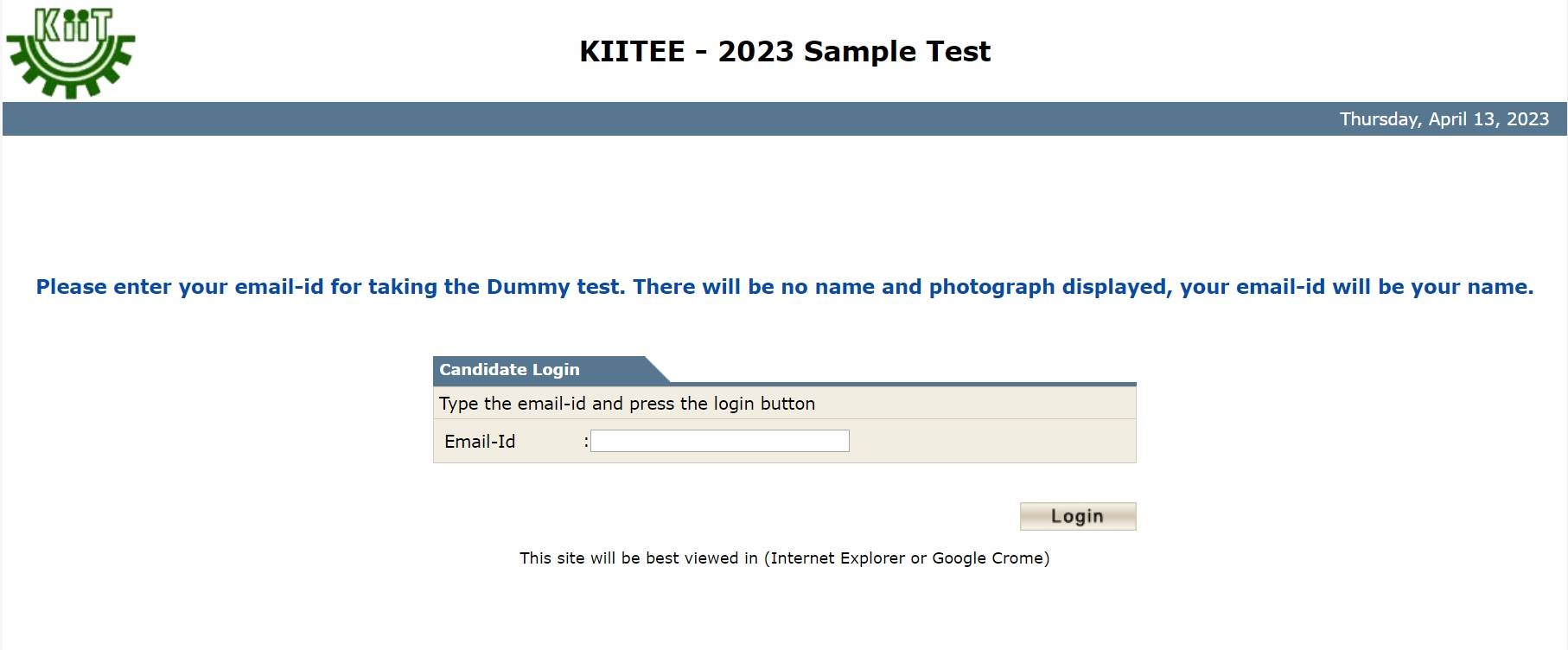
Candidates can access the direct link for the KIITEE mock test below. Students must check how to take KIITEE 2026 mock test before attempting the test.
Direct link: KIITEE Mock Test Link
- Login- Candidates must log in to attempt the mock exam.
-
Start the mock test- Log in and click on the 'Take Assessment Test' link. A page with test instructions will appear on your screens; read all the instructions for KIITEE 2026 mock test and click on the 'I Agree' button.
- Attempt the KIITEE Mock Test 2026- The test will start and candidates can keep track of the time using the automatic clock. It will have multiple-choice questions with four options.
- Submit Mock Test- Once you are done with the test, click on the 'Submit and Close My Test' button.
- Feedback- In the end, give your feedback and download the scorecard online.

Commonly asked questions
Yes. Candidates can choose their preferred KIITEE exam date through the slot booking facility.
The phase-wise KIITEE 2026 exam date is given below.
KIITEE 2026 Phase I Exam Date - April 16 to 20, 2026
KIITEE Phase II Exam Date 2026 - June 4 to 8, 2026
KIITEE Phase III Exam Dates - July 5 to 7, 2026
KIITEE Mock Test 2026 - Color Coding
- Green: The colour is for the answered question
- Red: This means candidates have visited the question but not answered it
- Grey: This is for when the question has not been visited by the candidate
Candidates can take the KIITEE mock tests to understand the exam format, marking scheme, and exam difficulty level. The mock test link will be available before the exam. The exact dates for KIITEE mock test 2026 has not been announced yet. However, the authority has announced the KIITEE 2026 exam dates online. The phase 1 exam will be held from April 16 to 20, phase 2 will be held from June 4 to 6, while phase 3 will be conducted from July 5 to 7, 2026.
Commonly asked questions
The KIITEE BTech entrance exam is considered mainly moderate level, and can be easy if the fundamentals are right. The KIITE BTech question paper is curated with questions focusing on the core concepts of Physics, Chemistry, and Mathematics. If compared to JEE Main and WBJEE, the difficulty level is on the easier side. To understand more about the question pattern and format of the questions, candidates can refer to the KIITEE sample paper available on its official website.
The KIITEE Engineering (BTech) question paper comprises three sections, namely- Physics, Chemistry, and Mathematics. Each section carries a total of 40 questions, i.e, Physics - 40 questions, Mathematics - 40 questions, and Chemistry - 40 questions. For each correct answer, 4 marks will be rewarded. A negative marking of one mark is deducted for an incorrect answer. The total marks allotted for the KIITEE BTech question paper is 480 marks.
Benefits of Solving KIITEE Mock Tests
- Taking a mock test acquaints the test takers with the pattern and KIITEE syllabus. Candidates can also get an idea of the kind of questions that are frequently picked in the exam.
- Practising as many mock tests as possible is the key to cracking any of the entrance exams. By regularly attempting mock tests, candidate ascertains their strong and weak areas and can work on them accordingly to ace the exam.
- Candidates willing to improve their speed must attempt the KIITEE mock test. This can be done by dedicating a particular time slot to each type of question and trying to solve them within the set time. This way, candidates will focus on both speed and accuracy.
- Since the KIITEE mock test is similar to the actual question paper, candidates will get a real-time exam day feel and pressure while taking the test.
Commonly asked questions
Yes, covering NCERT books for KIITEE is enough for preparation. NCERT books help candidates to understand the basic concept effectively. Along with the NCERT books, candidates can also refer to the KIITEE syllabus and exam pattern for preparation. By referring to the NCERT books, candidates can revise the important concepts. The answers also provide basic structure to students which they can use to frame their own answers. NCERT books are provided for all subjects: Physics, Chemistry, Biology and Mathematics.
Candidates should give equal time to all the chapters and topics given in the syllabus of KIITEE. Candidates can also practice the syllabus and mock test. Applicants have to start preparing the topics with high weightage, followed by other topics. The revised KIITEE syllabus needs to be kept for the last few days prior to the examination.

KIITEE 2026 Syllabus
The KIITEE 2026 syllabus has been published for the candidates' reference. Candidates must prepare all the chapters and topics given in the syllabus. The KIITEE syllabus 2026 is different for all courses. Thus, students should be aware of the syllabus for the course they applied for in KIITEE 2026. The KIITEE BTech syllabus has topics from Physics, Chemistry, and Mathematics, while the syllabus for BTech Biotechnology includes Mathematics, Physics, Chemistry, and Biology.
KIITEE Syllabus 2026
| Physics |
Chemistry |
Mathematics |
|---|---|---|
| Units and Measurement |
Some Basic Concepts |
Sets, Relations and Functions |
| Description of Motion in One Dimension |
States of Matter |
Complex Numbers |
| Description of Motion in Two and Three Dimensions |
Atomic Structure |
Matrices and Determinants |
| Laws of Motion |
Solutions |
Quadratic Equations |
| Work, Energy and Power |
Chemical Energetics and Thermodynamics |
Permutations and Combinations |
| Rotational Motion and Moment of Inertia |
Chemical Equilibrium |
Binomial Theorem and Its Applications |
| Gravitation |
Redox Reactions and Electrochemistry |
Sequences and Series |
| Solids and Fluids |
Rates of Chemical Reactions and Chemical Kinetics |
Differential Calculus |
| Oscillations |
Surface Chemistry |
Integral Calculus |
| Waves |
Chemical Families Periodic Properties |
Differential Equations |
| Heat and Thermodynamics |
Chemical Bonding & Molecular Structure |
Two-Dimensional Geometry |
| Transference of Heat |
Chemistry of Non-Metals - 1 |
Three-Dimensional Geometry |
| Electrostatics |
Chemistry of Non-metals-II |
Vector Algebra |
| Current Electricity |
Chemistry of Lighter Metals |
Measures of Central Tendency and Dispersion |
| Thermal and Chemical Effects of Currents |
Unit 15:- Heavy Metals |
Probability |
| Magnetic Effects of Currents |
Chemistry of Representative Elements |
Trigonometry |
| Magneto Statics |
Transition Metals Including Lanthanides |
|
| Electromagnetic Induction and Alternating Currents |
Coordination Chemistry and Organo Metallics |
|
| Ray Optics |
Nuclear Chemistry |
|
| Wave Optics |
Purification and Characterization of Organic Compounds |
|
| Electromagnetic Waves |
Some Basic Principles |
|
| Electron and Photons |
Hydrocarbons |
|
| Atoms, Molecules and Nuclei |
Organic Compound Containing Halogens |
|
| Solids and Semi-Conductors Devices |
Organic Compounds Containing Oxygen |
|
| Organic Compounds Containing Nitrogen |
||
| Synthetic and Natural Polymers |
||
| Bio Molecules and Biological Processes |
||
| Chemistry In Action |
||
| Environmental Chemistry |
KIITEE Exam Pattern 2026
Kalinga Institute of Industrial Technology (KIIT) has released the KIITEE 2026 exam pattern on the website. The pattern comprises details on the exam duration, marking scheme, type of questions, and other details. Applicants appearing for the exam must refer to the KIITEE exam pattern for their preparation. Applicants can also go through the KIITEE mock test and the exam pattern. For more details, candidates can refer to the table given below.
| Exam Structure |
Details (BTech) |
Details (BTech - Lateral Entry) |
|---|---|---|
| Exam mode |
Online |
|
| Number of sections |
3 (Physics, Chemistry, Mathematics) |
3 (Mathematics, Basic Electrical Engineering, Engineering Mechanics) |
| Duration of exam |
150 minutes |
|
| Number of questions |
120 |
|
| Type of questions |
MCQs |
|
| KIITEE exam total marks |
480 |
|
| Language of paper |
English |
|
| Number of answer choices |
4 |
|
| KIITEE marking scheme |
+4 marks for correct answer -1 mark for incorrect answer |
|
Also Read:
Commonly asked questions
The exam authority mentions the KIITEE syllabus on the official website. The syllabus for Physics section has both experimental and theory questions. For more details, candidates can check the information below. Physics and measurement Rotational Motion Thermodynamics Kinematics Work, energy and power, Properties of solids and liquids Gravitation Laws of Motion Oscillations and Waves Electronic devices Kinetic theory of gases Current electricity.
The Kalinga Institute of Industrial Technology has released the KIITEE syllabus online. The syllabus lists the important topics and chapters covered in the exam. KIITEE syllabus 2026 for B.Tech entry comprises topics from Physics Chemistry and Mathematics. It is similar to the 12th-class syllabus.
KIITEE 2026 Exam FAQs
Candidates can check the KIITEE 2026 exam FAQs below.
The KIITEE 2026 slot booking date will be announced online. It is typically available along with the hall ticket download.
KIIT University offers admission to UG & PG courses in engineering, pharmacy, management, science, and more. The University conducts an entrance test, known as KIITEE for admission to all courses except MBBS and BDS courses. The university also accepts other entrance test scores, such as JEE Main, CAT, XAT, GMAT, etc., for admissions. The KIITEE 2026 Application form is available at kiitee.kiit.ac.in. There is no application fee for the KIITEE registration.
Candidates appearing in the exam are advised to refer to the best books to prepare for KIITEE 2026. Applicants can check KIITEE 2026 best books below.
Physics
- Objective Physics Arihant Publications
- Concept of Physics Volume 1 & 2, HC Verma
- Fundamentals of Physics Halliday, Resnick and Walker
- Problems in Physics A. A Pinsky
Chemistry
- Organic Chemistry O. P Tandon
- Inorganic Chemistry O. P Tandon
- NCERT Chemistry Class 11 & 12
- Organic Chemistry Arihant Prakasan
Mathematics
- Mathematics for class 11 and 12, R. D Sharma
- Higher Algebra Hall Knight
- Complete Mathematics, MC Graw Hills.
Yes, candidates are advised to cover the complete syllabus for their preparations. Do not leave any top untouched. The exam paper of KIITEE comprises questions from all the topics. To prioritise the topics, candidates can pick high-weightage topics first. Leaving any topic will increase the Probability of losing marks.
Kalinga Institute of Industrial Technology conducts KIITEE exam every year for admissions to various courses. Applicants looking for admissions are advised to first go through the KIITEE syllabus thoroughly. It helps candidates to prepare an effective strategy to ace the exam with a good score. Along with the syllabus, applicants must also go through KIITEE exam pattern to understand the scheme of the exam. Applicants are advised to study regularly with short breaks. Do not take much stress. It is important to understand the basic concept. Regular practice helps to boost confidence of students.
Explore subject-wise topics asked in KIITEE
Select your preferred subject
KIITEE Exam
Student Forum
 Anything you would want to ask experts?
Answered 5 days ago
Yes, KIITEE is complulsory for KIIT School of Public Health MPH admission. The college offers the programme at the PG level and selects students based on KIITEE score. Students also have to appear for counselling rounds to get selected.
A
Contributor-Level 10
Answered 2 weeks ago
The following documents are required to be submitted by the candidates at the time of KIITEE GD & PI.
- High school certificate and mark sheet
- +2 certificate and mark sheet
- Graduation certificate and all semester mark sheets
- Entrance score card
- Passport photograph
S
Contributor-Level 10
Answered 2 weeks ago
S
Contributor-Level 10
Answered 3 weeks ago
The final deadline for KIITEE registrations for KIIT School Of Public Health MHA admissions is scheduled on July 1st for the academic year 2026.
The aforementioned date is the last date to apply for the third and final round of KIITEE 2026. Candidates who miss this deadline will need to wait for KII
S
Contributor-Level 10
Answered 3 weeks ago
Yes, the KIITEE registrations for the academic year 2026 are open for KIIT School Of Public Health MHA admissions. Currently, the first phase of KIITEE registrations is ongoing at KIIT Deemed to be University. The last date to apply for the first session of KIITEE 2026 is scheduled on April 8th.
S
Contributor-Level 10
Answered a month ago
The KIITEE 2026 exam will be held for 480 marks. The exam will have 120 questions for B.Tech, and each question will be worth 4 marks. Students have to be careful as there is a negative marking of 1 mark for every incorrect answer.
S
Contributor-Level 10
Answered a month ago
The KIITEE exam is not considered very difficult. Candidates who are already preparing for the JEE Main exam or other engineering entrances can easily crack the exam if they practice enough mocks and sample papers. Moreover, a thorough revision of the topics in the KIITEE syllabus will help candidat
S
Contributor-Level 10
Answered 2 months ago
KIIT School of Law activates the KIITEE Law or K-LAT admit card link on the official website. Students have to provide the login credentials to download the admit card for the Kalinga Law Admission Test. After downloading, verify the printed details.
S
Contributor-Level 9
Answered 2 months ago
Candidates have to follow the given K-LAT exam day guidelines on the exam day.
- Do not carry any papers, books, notes, electronic devices, or any other material or information relevant to the examination concerned.
- Do not carry Calculators, Log Tables, Electronic Digital Watches with, calculators, mobi
S
Contributor-Level 9
 KIITEE Notifications
7 Institutes accepting KIITEE
KIIT School of Computer Engineering, Kalinga Institu...
Bhubaneswar • Private
 4.2
4.2KIIT School of Mechanical Engineering, Kalinga Insti...
Bhubaneswar • Private
KIIT School of Electronics Engineering, Kalinga Inst...
Bhubaneswar • Private
KIIT School of Electrical Engineering, Kalinga Insti...
Bhubaneswar • Private

Explore more B.Tech exams with upcoming dates
 TS EAMCET Application Form 2026 19 Feb '26 - 4 Apr '26 GITAM GAT 2026 Last date for payment of fees for scholarships candidates for current phase 4 Apr '26
Is KIITEE compulsory for MPH admission at KIIT School of Public Health?